Monday, December 24, 2012

A Christmas salad and chowder

My sister-in-law is planning to serve a crisp Romaine salad and a chowder that includes giant prawns, scallops and clams, and asked if I had a recipe for a good Caesar dressing and a nice chowder. Here were my recipes from the files, and I thought you might like to try them as well.

What are you fixing for Christmas dinner this year? I'd love it if you'd include your menu in a comment below, or send me an email.

Caesar dressing recipe
from Sallie Y. Williams' "The Complete Book of Sauces":

Ingredients
½ cup olive oil
½ teaspoon salt
6 anchovy fillets, rinsed, dried, smashed and chopped finely
2 tablespoons fresh lemon juice
1 large egg, soft-boiled for 1 minute
Freshly ground black pepper to taste
½ cup freshly grated Parmesan cheese

Instructions
For a rustic vinaigrette, put all the ingredients in a jar and shake until well mixed. For a more creamy dressing, put all ingredients but the Parmesan in a food processor or blender and mix until smooth. Add the cheese and stir.

If I'm not lazy, I rub the salad bowl with a clove of garlic for extra flavor. If I'm pressed for time, I use garlic salt in place of the salt. Also, since I know where my egg has come from and I wash it before using, I skip the soft-boiled step. (I think the lemon juice "cooks" the egg.)

Seafood Chowder
Serves 2 as a main course, 4 as a first

Ingredients
1 tablespoon olive oil
1 small onion, cut into 3/4-inch dice
2 sprigs fresh summer savory or thyme, leaves removed and chopped (1 teaspoon)
1 dried bay leaf
1/2 pound Yukon Gold, white or rose potatoes (not russet), peeled and diced in 1/2-inch chunks
1 1/4 cups fish or chicken stock, or clam juice
Kosher or sea salt and freshly ground black pepper
3/4 pound of the following: mixed shellfish or skinless haddock or cod fillets, totally deboned
1/3 cup heavy cream (or half and half, or milk, if a lighter soup is desired)

For garnish
1 ounce lean bacon bits or lardons
2 teaspoons chopped fresh Italian parsley
2 teaspoons minced fresh chives

Instructions
Heat a 2-quart heavy pot to medium hot. Add oil, onions, savory or thyme, and bay leaves to the pot and sauté, stirring occasionally with a wooden spoon, for about 5 minutes, until the onions are softened but not browned.
Add the potatoes and stock. If the stock doesn’t cover the potatoes, add just enough water to cover them. Bring to a boil over higher heat, cover, and cook the potatoes vigorously for 5-10 minutes, until they are soft on the outside but still firm in the center. If the stock hasn’t thickened lightly, smash a few of the potato chunks against the side of the pot and cook for a minute or two longer. Reduce the heat to low and season with salt and pepper (you will want to almost overseason the chowder at this point to avoid having to stir it much once the fish is added). Add the seafood or fish fillets and cook over low heat for 5 minutes, then remove the pot from the heat and allow the chowder to sit for 10 minutes (the fish/seafood will finish cooking during this time).
Gently stir in the cream and taste for salt and pepper. If you are not serving the chowder within the hour, let it cool a bit, then refrigerate; cover the chowder after it has chilled completely. Otherwise, let it sit for up to an hour at room temperature, allowing the flavors to meld. When ready to serve, reheat the chowder over low heat; don’t let it boil. 
Warm the bacon or lardons in a low oven (200 °F) for a few minutes.
Use a slotted spoon to mound the chunks of fish and/or seafood, the onions, and potatoes in the center of large soup plates or shallow bowls, and ladle the creamy broth around. Scatter the bacon over the individual servings and finish each with a sprinkling of chopped parsley and minced chives.

Saturday, December 22, 2012

Brown sugar, how come you dance so good?

Photo: © Lori Korleski Richardson
I love gooey, chewy caramel. But as I've gotten older, my teeth just can't handle it, and I'm tired of losing fillings to my sweet addiction.

I thought I'd try my hand this Christmas season at making some, but every recipe I found for caramels included corn syrup, which I refuse to buy. So what to do?

Then I remembered pralines. You can make them like caramels, or like a brown-sugar candy. I love both kinds, but thinking of my teeth, I opted for the latter. They are pretty easy to make. It helps if you have a candy thermometer, but that's no guarantee that they will set up. One sheet of mine did, the other didn't. Go figure. I put them in the freezer if they don't set up and use them for topping vanilla yogurt or ice cream.

Note: I keep my unsalted butter in the freezer. To use, I shred what I need with a grater. It comes to room temperature very quickly that way.

Lori K's Pralines
Makes 24 smallish ones

Ingredients
1 1/2 cups of brown sugar (I like dark best)
1/2 cup heavy cream
1/2 teaspoon vanilla
4 tablespoons butter, shredded
1 cup pecans, coarsely chopped, plus 12 halves for decoration

Instructions
Melt the sugar and cream in a heavy pan over medium heat, using a silicone spoon to stir. Once it melts, turn up the heat a little and put in the candy thermometer, if using. Cook to soft-boil stage, 240 degrees, about 12 minutes. Turn the heat to simmer and let it cool down to 220 degrees. Add the vanilla and butter, and cook at 220 degrees for about 6 minutes until it's all well blended. Add the pecans and stir well.
Line two cookie sheets with parchment. Drop a spoonful of the mixture on the sheet, three across and four down. Top each with a pecan half. Repeat on the second sheet. The candy will harden as it comes to room temperature.

Wednesday, December 12, 2012

Something fishy going on

National Geographic photograph
A recent New York Times article says that you might not be getting the fish you're paying for. For instance, the Oceana researchers who analyzed the DNA of 150 samples of fresh fish found that 13 types of fish, including tilapia and tilefish, were falsely identified as red snapper. Tilefish contains such high mercury levels that the FDA advises women who are pregnant or nursing and young children not to eat it. And 94 percent of fish sold as white tuna was not tuna. Much of it was escolar, which contains a toxin that can cause severe diarrhea if more than a few ounces of meat are ingested.

How can you be sure what you're eating? The FDA is stepping up its testing nationwide and adding DNA sequencing equipment to its field labs. It has collected hundreds of fillets from wholesalers for testing to determine the frequency of mislabeling and where to aim enforcement efforts.

When you hear someone say that the private sector can police itself, you might ask them how that would work for problems such as this.

Monday, November 12, 2012

A new look at Thanksgiving side dishes

Tired of green bean casserole? Can't stomach another candied yam dish?

Food & Wine has some unusual but very delectable ideas in a slideshow that can be viewed by clicking here.

Thursday, November 1, 2012

Turkey tips - what NOT to do

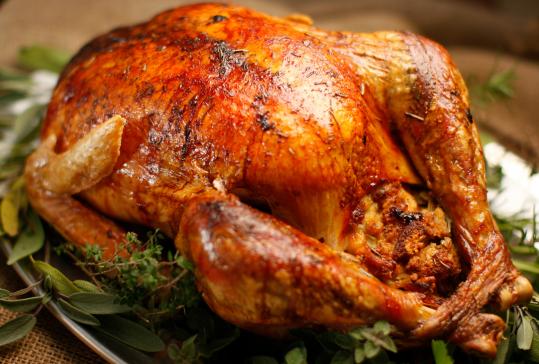
The photo-op turkey
These tips were published last year in Food & Wine, but they're still good advice for the coming holiday. I cook four turkeys every Wednesday before Thanksgiving to feed about 80 people at St. Paul's Memorial Church. Please join us if you can; we ask those who are planning to come to call the office at (434) 295-2156 and let us know what side dish you'd like to bring.

I've taken the liberty to add some of my own hints to Alessandra Bulow's excellent ones.


5 Easy Ways to Ruin the Thanksgiving Turkey
BY ALESSANDRA BULOW | POSTED NOVEMBER 10, 2011 

You’ve reserved a beautiful bird, found a big enough pan (that fits in your oven!) and purchased an instant-read thermometer to roast your Thanksgiving turkey to a perfectly moist 160–165°F—but there's still room to go wrong. Here, F&W’s Senior Recipe Developer Grace Parisi reveals the biggest turkey mistakes made by home cooks.

For a better-tasting bird, divide and conquer
1. Overstuff the cavity. By the time the stuffing reaches a safe temperature (165 °F) in an overstuffed bird, the white meat will be totally dried out. Parisi’s rule of thumb: Cook no more than five cups of stuffing in a 15-pound bird and bake the rest in a separate dish. She also stuffs the neck, which won't increase overall cooking time.
My advice: Cook the stuffing, made with the broth from the giblets, in a casserole, and make a good gravy from the drippings to go over it.

2. Crowd the oven. Like a teenager, a roasting turkey likes privacy and space. Baking casseroles and other foods with the bird disrupts oven temperature and alters your turkey’s expected cooking time. Also, if the bird is placed too close to the top of the oven, the breast will dry out and the skin will burn; you should remove some of the higher oven racks to make room.
My advice: If your sides don't involve Parmesan or bread products, cook them ahead of time and warm up in the microwave. If they have a topping that needs to be crispy, cook them to almost done and cool.  Cook the turkey, take it out and cover it loosely, then turn up the heat. Take out the dishes that need oven time and cook 15 minutes or until bubbly.

3. Check the bird obsessively. Opening the oven door cools down the oven so much that you’ll end up increasing the cooking time by a lot.
My advice: Forget about basting. Brine or season well, make sure the skin is dry then well oiled, and don't overcook. Take it out when the instant read thermometer hits 160 degrees - it will gain another 5 degrees as it rests. If you really want the breast moist and the legs done, and don't need the bird for a photo op, separate them and cook the legs long and slow on the stove or in a crock pot, the breast in the oven. This also cuts down on the cooking time.

4. Carve the turkey immediately. Turkey needs to rest for at least 30 minutes to keep the juices from flowing out of the bird and drying out your meat. Resist the urge to carve right away and go freshen up. If guests aren't already waiting for you, they'll certainly be there soon.
My advice: That half hour is also a good time to finish the side dishes you've partially prepared in advance.

5. Brine a kosher turkey. Since a kosher turkey has already been treated with salt, brining it will yield an overly salty turkey.
My advice: Don't brine any turkey that says it has up to 15 percent saline solution added.

Sunday, October 21, 2012

Squash with panache

Plop. Plop. Plop-plop-plop-plop-plop-plop-plop. It's raining acorns outside. Last year, the oak trees gave up so few that there were notes on Freecycle.com begging for anyone who had a bucket of acorns in their garage to please share for their squirrels. The oaks have more than made up for their previous year's stinginess.

It's also the time of year when acorn squash plop, plop, plop down in the stores as well. They look very cheerful with their pointy tips, deep green and orange coloring and scalloped exterior. I think that's why many people just half them, cook them face down on a cookie sheet, then serve them drizzled with maple syrup. Pretty easy, and a half of squash is a hearty portion for one person, a healthy alternative to a baked potato drizzled with butter and stuffed with sour cream, cheese and bacon bits.

Yet, I never much liked them. I pondered whether it was the texture, which can be a bit more stringy than butternut squash or pumpkin, or was it the maple syrup? Thinking it might be the latter, plus the blandness of the vegetable once the coating was eaten, I decided to try to peel the squash and roast it.

Peeling turned out to be the most time-consuming part, because of its scalloped shell. But once that was done, the rest couldn't be easier.

Lori K's pork tenderloin with roasted acorn squash
Serves 2

Ingredients
1 acorn squash, seeds removed, peeled and diced into 1" chunks
1 tablespoon chili powder
1 teaspoon garlic salt
1 teaspoon cumin
1 tablespoon olive oil
1 pork tenderloin
Spice rub
2 quarters of cabbage
Salt and pepper to taste
Butter, optional

Instructions
Preheat oven to 500 degrees.
In a dutch oven or enameled iron casserole, toss the squash with chili powder, garlic salt, cumin and oil until well coated. Cook for 15 minutes.
Coat all sides of the tenderloin with your favorite spice rub (I used Mas Guapo; it's spicy and a little sweet).
Remove the pan from the oven and lay the tenderloin on top. Cook for 20-25 minutes until the squash is very tender and the pork is 160 degrees in the center. Take out of the oven and wait 5 minutes for the juices to reabsorb into the meat.
While the meat is resting, put the cabbage in a microwave safe dish, season with salt and pepper to taste and cook for 4 minutes on high, or until tender but still bright green. Add a pat of butter while hot, if desired.
Remove meat to a cutting board and slice thinly. Divide onto 2 plates and pour any juices over the meat. Fill out plate with half the squash, and a cabbage wedge. Serve.

Note: There are usually two tenderloins in a pack; if you get a pack that's about 2 pounds, one will be just about the right amount for two people. You can cook both of them and have meat for sandwiches for the next few days.

Wednesday, October 17, 2012

Nothing fishy about marinated salmon

If you've been lucky enough to have a friend of Scandinavian descent bring gravlax to a party, you know how delicious marinated salmon can be. You may also have thought, "What a lot of work" or "I could never eat that much fish at home." Also, it may be hard to find fresh dill at certain times of the year.

A side of salmon is a pretty party dish, but a bit impractical for a weeknight dinner unless you regularly feed a dozen or so people a sitting.

But marinated salmon can be a blessing when you buy a fillet and find yourself invited out for dinner or an unexpected meeting demands your presence. When you get home, fix the smaller recipe below, and a few days later, slice, add bread and a green salad and you've got a light midweek meal.

First, the original recipe, for a whole side of salmon, filleted, from Trina Hanemann's "The Scandinavian Cookbook" (Andrews McMeel Publishing, 2008, 224 pages, $30).  My version for a half-pound salmon fillet is below it.

Marinated Salmon 
Serves 20-24

Ingredients
1 orange
1 lemon
1 1/2 cups superfine sugar
10 ounces sea salt
1 side of salmon, filleted
For serving:
1 orange
1 lemon
Toasted bread
Green salad

Instructions
If you have a zester, use it to remove the zest from the orange and the lemon it will look fresh and tasty.  Alternatively, finely grate the zest from the fruit. Mix the zest with the sugar and salt.
Use tweezers to remove any pin bones from the salmon fillet. Spread the zest mixture evenly over the entire surface of the salmon, then wrap it in plastic wrap and refrigerate for 3 days.
After 3 days, take the salmon out of the refrigerator, remove the plastic wrap and wipe off the marinade with a paper towel. Wrap the salmon in plastic wrap and freeze for 12 hours, then take it out of the freezer and defrost it.
Before it is completely thawed, put the salmon on a board and cut it into thin slices with a very sharp knife. The traditional cutting technique starts diagonally at one corner of the salmon and works toward the center of the fillet.
To serve, remove the zest from the remaining orange and lemon and sprinkle it over the salmon. Serve with toasted bread and a green salad.

Lori K's little marinated salmon
Serves 2

Ingredients
1 lemon
1/4 cup sugar
1 tablespoon kosher salt
1/2 pound salmon fillet
Crusty bread
Salad

Instructions
Zest the lemon; save the fruit. (Wrap it in plastic to keep it from drying out and put it in the refrigerator.)
Combine the sugar and salt in a clean coffee mill and blend until the sugar is superfine. Add to the zest.
Pull out with tweezers any bones left in the fillet. Spread the sugar mixture over the fillet and either put it in a covered glass dish, or wrap in plastic, and put in the refrigerator.
After three days, take it out, wipe off the marinade with a paper towel, rewrap it and put it in the freezer while you're at work. When you come home, take it out of the freezer to defrost. When it is almost defrosted, cut it in thin slices diagonally with a sharp knife and remove them from the skin.
Arrange on plate. Cut the reserved lemon in half, remove the seeds and squeeze over the salmon. Serve with crusty bread and salad.